Economic Sustainability Management
Impact Management to Stakeholders in the Business Value Chain
The Company puts emphasis on the impact management to stakeholders in the business value chain, beginning from the upstream to downstream activities to drive the operations for sustainability and to mitigate risks from business operations relevant to sustainability matters. Activities and target groups have been analyzed, the participatory engagement process has been created and hopes of the organization’s stakeholders has been responded as follows:
Business Value Chain
Primary activities of the Company consist of:

1. Raw Material Procurement
All slab raw materials are sourced entirely from overseas, with procurement diversified among producers across multiple regions worldwide in order to strengthen supply security and reduce the risk of reliance on any single source. In 2025, the Company procured raw materials from producers in five principal regions: East Asia, Southeast Asia, South Asia, Africa, and the Middle East. Procurement was conducted through monthly negotiations, both via distributors and through direct purchases from producers, with primary consideration given to prevailing market conditions and cost structures.
The Company manages its raw material sourcing within a cooperative framework with distributors and producers through the exchange of indicative demand forecasts on an annual or quarterly basis. Such information is used to support producers’ allocation planning when offering slab volumes for sale. This arrangement does not constitute a binding purchase commitment; however, it enhances raw material readiness and supports overall supply chain continuity.
In 2025, the global geopolitical environment remained uncertain due to international conflicts and the implementation of trade measures by major economies, resulting in volatility in global steel supply and demand. Nevertheless, these conditions led to surplus raw material availability in the global market and provided
Amid these circumstances, the Company expanded its raw material sourcing base by procuring from three new suppliers in East Asia, strengthening raw material security and supporting the continuity of its business operations.
2. Product Manufacturing
The Company operates the production of hot-rolled coils using an automated manufacturing process and continuously enhances its production processes by applying modern technologies. At the same time, the Company conducts its operations in accordance with an internationally recognized Quality Management System (QMS) to ensure that its products meet consistent quality standards and are able to reliably fulfill customer requirements.
The Company is also well prepared to systematically adjust its production processes to keep pace with changes in customer demand and the increasingly dynamic business environment.
Furthermore, the Company is committed to fostering a culture of continuous improvement through various initiatives across the organization, such as Kaizen activities, the promotion of engineering excellence and engineering improvement, research and development (R&D), the implementation of Total Productive Maintenance (TPM), the execution of Quality Control Circle (QCC) activities, and the encouragement of cross-functional teamwork in the form of Task Force Groups. These initiatives contribute to continuous improvements in production efficiency and operational performance, while also supporting effective cost control to maintain competitiveness.
3. Sales and Marketing
The Company supplied hot-rolled coils to various industries, i.e., the automobile industry, electrical appliance industry, construction industry, packaging industry, etc., by placing importance on customers of all industrial groups. The Company applied the sale policy appropriate with each industry and customer by offering as forward sale, quarterly sale, monthly sales and spot sale to minimize fluctuation in the industrial markets which used steel as raw materials. The Company maintained balance between selling prices and costs of raw material for fairness and business security of the trade partners, and the relevant parties. Moreover, price structure and trading format have been adjusted to make them appropriated with the marketing situations, both domestically and internationally, to prevent dumping and unfair imports of goods. The Gold Partnership Program has been developed to enhance stability and continuity in the supply value chain and to reduce risks during the sluggish market conditions, and out-of-stock situation.
In terms of management, the Company analyzes and plans sales in accordance with orders, while efficiently managing raw materials, production, and product delivery with aims to shorten the delivery time of products to meet customer needs in a timely manner.
Furthermore, the Company has supported government policies promoting the use of domestically manufactured products by obtaining MiT (Made in Thailand) certification for its products. This certification, granted to products manufactured in Thailand in accordance with the criteria of the Federation of Thai Industries, affirms the quality and standards of Thai products. It also encourages government agencies, the private sector, and the general public to increasingly choose products made in Thailand, thereby supporting stable and sustainable economic development of the country.
4. Product Delivery
The Company places great importance on ensuring that product deliveries are safe, accurate, meet customer requirements, and are made on time. The Company continuously controls and improves all processes related to its delivery operations, covering internal processes, transportation, and final delivery to customers in a safe and reliable manner. All processes are conducted in strict compliance with safety standards, relevant laws, social regulations and requirements, as well as each customer’s specific rules and regulations.
The Company closely monitors its operations and establishes clear performance criteria, evaluation systems, and continuous improvement measures for its delivery processes. Examples include the establishment of a joint logistics monitoring team between the Company and its transportation contractors, as well as activities organized through the Bang Saphan Transport Operators Club and the Operation Control Center (OCC), which operates 24 hours a day. The OCC serves as a central hub for tracking shipments from origin to destination and for receiving complaints and suggestions from all stakeholders for further improvement and efficiency enhancement.
In addition, the Company is committed to environmental responsibility and has improved its delivery processes under the green supply chain concept. The Company has set a target to reduce carbon emissions by at least 2%.
5. After-Sale Services
The Company provided the channels to communicate, receive complaints, suggestions, and feedback from customers by focusing on speedy services to gain competitive advantage from customers’ business by setting target on after-sale service that complaint must be finalized within 15 days. Meeting has been arranged to monitor usage of products with the customers, as well as developing products and services to conform to the customers’ business operation continually. The Company also listened to and asked for recommendations on usage of the customers of all market groups (Empathy Program) for improvement, rectification, and development of products and services. The customer satisfaction survey is conducted every year. The information obtained has been used to analyze and figure out solutions of the issues that the customers placed importance to, and to provide knowledge and advice to customers in various matters.
Stakeholder Analysis in the Business Value Chain
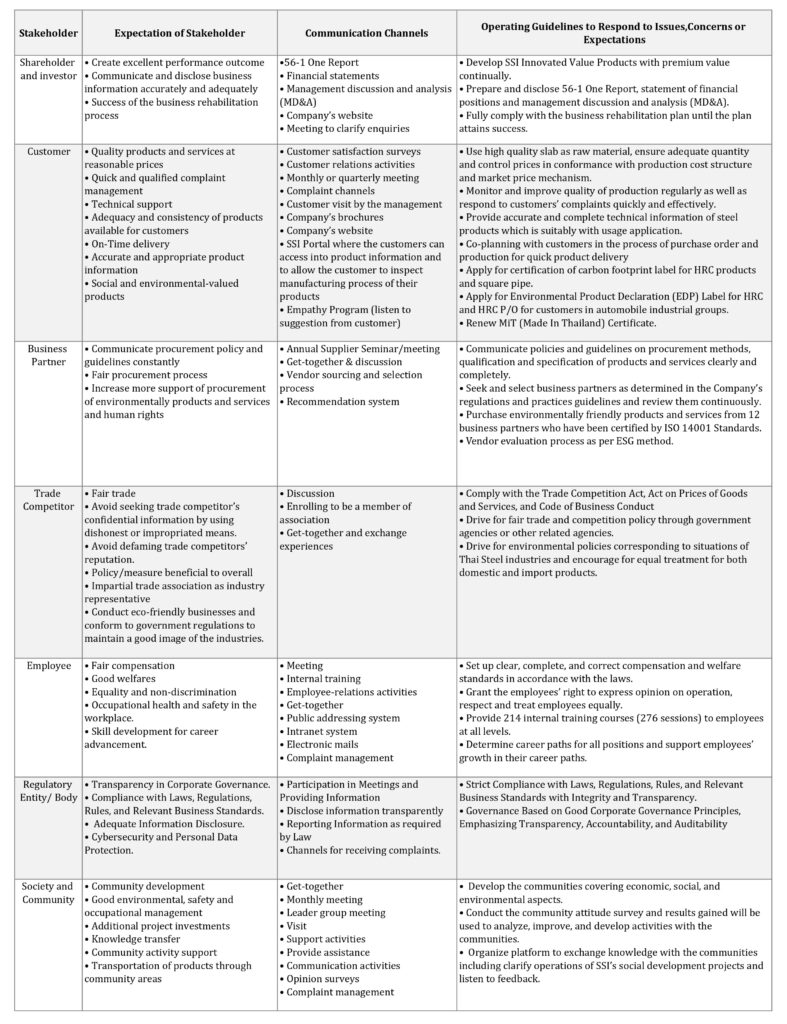
Sahaviriya Steel Industries Public Company Limited puts an emphasis on business value chain and divided the stakeholders into 7 groups: 1) Shareholder and investor, 2) Customer; 3) Business partner; 4) Trade competitor; 5) Employee 6) Regulatory entity, and 7) Society and community. Any impacts to the stakeholders shall be managed by the Company’s responsible agencies.
Stakeholders Analysis in the Business Value Chain in 2025
Materiality Assessment on Sustainability
The Company conducted materiality assessment on sustainability and prioritized such matters which covered the review of present and future risks and business opportunity by considering from significant impacts toward business operations, expectation level of stakeholders, both within and outside the organization, to reflect the environmental, social, governance issues and effective value chain management.

Innovation Development
Innovation Policy
Innovation is a key driver enabling the organisation to remain competitive in the market. Sahaviriya Steel Industries Public Company Limited, a leading producer of hot-rolled steel sheet in coils in Southeast Asia, conducts its business with a continuous focus on fostering innovation across products, services, and internal processes. The Company recognises that innovation management is essential to its business operations in order to sustain stakeholders’ trust over the long term. Accordingly, the Company has established its innovation policy as follows:
“Foster innovation across processes and services, and develop differentiated products
within the Company’s strategic framework.”
To ensure that innovation activities are aligned with the established policy, the Company has defined the following innovation management guidelines:
- Govern, support, and establish policies and objectives for innovation in processes and services, and the development of differentiated products, in alignment with the Company’s strategy.
- Promote and drive the development of new innovations in processes and services, and differentiated products that create added value for the Company and its customers.
- Monitor, assess, and review innovation outcomes to ensure tangible benefits and measurable returns to the Company.
The Company is committed to maintaining an effective innovation management system. This innovation policy will be communicated to employees at all levels to foster awareness and a strong commitment to continuous improvement and development.
Development of innovation management system and business innovation
The process of innovation is crucial and must be systematically managed to maintain a continuous response to the competition. In this regards, the Company has embraced the idea of innovation management by implementing ISO 56002 innovation management systems since 2022 and was verified by a leading certification body, MASCI. SSI is the first hot-rolled steel sheet manufacturer in Thailand who has successfully passed the certification process and obtained the ISO 56002 innovation management system certification to create valuable products and services for customers and society.
Innovate premium value steel product
Hot-Rolled Coil, which is a raw material for several industries such as heavy construction, steel pipe, gas cylinder, automotive parts, electric appliance, steel furniture, container, cold rolling, boiler, pressure vessel, shipbuilding and coil service centre, etc.
Hot-rolled steel sheet in coil includes:
• Hot-rolled Coil (HRC) for domestic use according to TIS standard and international standards including Japanese, American, DIN and British with width between 750 and 1,565 mm and thickness between 0.90 and 20.00 mm The hot-rolled coil capacity expansion project, to expand production capacity to 4 million tons per annum, was completed in February 2005. The production capability has been improved to produce hot-rolled coils with thickness ranging from 0.90 mm to 22.00 mm with continuous improvement and reduced cost. SSI has been one of a few mills which could produce commercial hot-rolled steel sheet in coil at 0.90 mm in thickness and achieved production at 0.80 mm in thickness presently.
• Hot-rolled Coil Pickled & Oiled (HRC P/O) or “CleanStrip”, high-grade product, are delivered to the automotive industry or for use in electrical appliances. The width is between 750 and 1,550 mm and thickness between 1.2 and 7.00 mm. This production has been under way since May 2004.
Additionally, the company consistently focuses on developing differentiated products to enhance product quality, meeting customer needs while striving to become a leader in the high-quality hot-rolled steel market. The company emphasizes innovation in steel products and value-added services for customers and consumers. These include customized products tailored to specific customer requirements, high-strength hot-rolled steel, and Innovated Value Products (IVP), which feature unique designs and specialized quality control distinct from SSI’s core products to create added value for customers. Furthermore, the company offers unique products that are exclusive to SSI
In 2025, the Company successfully developed three value-added products and services for its customers, as outlined below:
- HRC-WF400 is a hot-rolled steel product with a wrinkle-free surface finish, designed for the machinery industry and applications requiring a smooth, high-quality painted surface.
- SM490YA – 1.50 mm is an ultra-thin, high-strength hot-rolled steel product for the construction industry. It enhances structural strength while reducing weight, supporting more efficient material usage and environmentally friendly construction practices.
- QSTE500TM and QSTE550TM are high-strength hot-rolled steel products manufactured in accordance with Chinese standards for the automotive industry, supporting the expansion of Chinese automotive manufacturers’ investments in Thailand.
For supporting the government’s policy about xEV electric vehicles (hybrid, plug-in hybrid, EV, fuel cell), the Company has developed High Tensile (Tensile 650 MPa) for the automotive industry, the product offering lightweight materials and lighter body for vehicles. SSI is also developed strength of steel up to Tensile 780 MPa and supporting the government’s machinery industry development policy, which will lead to driving economy and create demand for more steel consumption.